
NetSuite order management is designed to optimize internal operations—but customer experience often becomes an afterthought. While NetSuite excels at managing complex order lifecycles behind the scenes, many organizations still rely on static emails, PDFs, and manual follow-ups to communicate with customers. That gap between internal efficiency and external experience creates unnecessary friction, delays payments, and increases support overhead. To truly maximize the value of NetSuite order management, businesses must extend it beyond the ERP and turn order data into a self-service, customer-friendly experience.
What if you could turn every step of your order management process into a self-service experience that delights customers and accelerates your operational workflows? That’s where modern tools like a NetSuite Customer Portal or NetSuite Self-Service Portal bridge the gap between internal ERP processes and real-world customer expectations.
NetSuite Order Management with Smartes
Smartes allows customers to view their orders and provide them with comprehensive information. The views have both and overview and detailed view component. The following is a diagram of the overview view which is useful for providing customer a lot of information regarding their order including order status tracking and option to click into an expanded details view of the order.
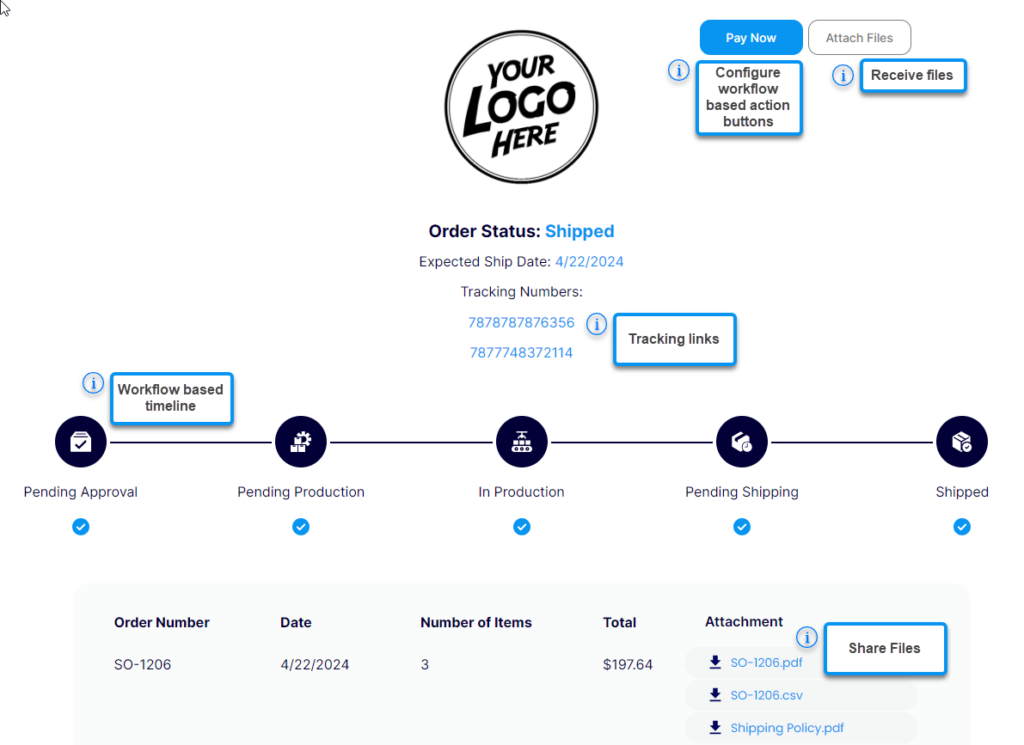
The above picture provides a breakdown for the overview view. The views and configuration are very dynamic and can accommodate many requirements:
- Action Buttons: Action buttons can be configured for a wide array of purposes. Whether it is receiving a customer approval or requiring customer payment.
- Status Timeline: The beauty of the status timeline is that it is configured using the NetSuite workflow engine. This means that each status timeline can be configured and business logic embedded within 1 workflow.
- Incoming Attachments: Allow customers to share files with you using the Attach Files button. This is useful for receiving information such as international documents from international customers or the customers purchase order.
- Outgoing Attachments: Share files with your customers such as the transaction PDF. The transaction CSV is useful to provide an importable format. Packing slips for example are often much appreciated by customers.
- Tracking Links: Providing shipping tracking links to your customer that are clickable to the shipping carriers tracking pages.
The Role of Customer Engagement in NetSuite Order Management
NetSuite order management is designed to handle complex workflows, from order creation and fulfillment to invoicing and billing. However, customer engagement is often limited to basic notifications and document delivery. Without a clear, self-service way for customers to interact with orders, businesses frequently encounter:
- Increased support inquiries related to order status and invoices
- Delayed payments due to unclear or fragmented payment processes
- Manual follow-ups to collect documents or confirmations
- Reduced customer satisfaction caused by lack of visibility
A more interactive approach allows customers to stay informed and engaged throughout the order lifecycle, reducing friction for both customers and internal teams.
Why Self-Service Matters
Self-service has become an expectation across nearly every industry. Customers want the ability to check order status, review invoices, and complete payments on their own time without contacting support. A NetSuite Self-Service Portal enables customers to:
- View real-time order and shipment information
- Access invoices and supporting documents
- Submit updates or confirmations when needed
- Take action without requiring NetSuite access or credentials
By providing this level of access, businesses reduce manual workload while improving the overall customer experience.
Extending Order Management Beyond NetSuite
One of the biggest challenges with traditional ERP workflows is that NetSuite is primarily designed for internal users. External access often requires Customer Center licenses, complex portal setups, or custom development.
A NetSuite Customer Portal addresses this gap by extending order management capabilities to customers and partners in a controlled, secure way. Rather than relying on static communication, customers can interact directly with order data that remains synchronized with NetSuite in real time. This approach allows businesses to:
- Reduce dependency on email and manual communication
- Improve accuracy by eliminating duplicate data entry
- Keep all interactions tied directly to NetSuite records
Connecting Orders and Payments
Order engagement does not end once an order is fulfilled. Payment is a critical part of the order lifecycle, and friction at this stage can delay revenue and increase administrative effort.
A NetSuite Payment Portal allows customers to review open balances and submit payments in context, directly tied to their orders and invoices. When payments are integrated with NetSuite order management, businesses gain real-time visibility into payment status while reducing reconciliation work.
This streamlined experience benefits both customers and finance teams by simplifying the path from order completion to payment.
The Business Impact of Better Engagement
Enhancing customer engagement within NetSuite order management leads to measurable operational benefits, including:
- Fewer support tickets related to order and invoice inquiries
- Faster payment cycles and improved cash flow
- Reduced manual data entry and administrative overhead
- A more professional and modern customer experience
By shifting routine interactions to self-service channels, organizations can scale more efficiently while maintaining strong customer relationships.
The Future of NetSuite Order Management
NetSuite order management provides a strong foundation for managing the order lifecycle, but businesses realize its full value only when customers can easily interact with the process. By incorporating self-service capabilities through a NetSuite Customer Portal and NetSuite Payment Portal, businesses can improve visibility, reduce friction, and strengthen customer engagement.
As customer expectations continue to rise, extending NetSuite order management beyond internal users is no longer optional—it is a strategic advantage. Contact us to learn how you can install this solution in your NetSuite environment.